Skip to content Skip to sidebar Skip to footer

Rest in Jasperreports Server Simple Svn Versioning and Continuous Integration

Welcome readers, in this tutorial, we will show how to use JasperReports with spring boot framework.

1. Introduction

  • Spring boot is a module that provides rapid application development feature to the spring framework including auto-configuration, standalone-code, and production-ready code
  • It creates applications that are packaged as jar and are directly started using embedded servlet container (such as Tomcat, Jetty or Undertow). Thus, no need to deploy the war files
  • It simplifies the maven configuration by providing the starter template and helps to resolve the dependency conflicts. It automatically identifies the required dependencies and imports them in the application
  • It helps in removing the boilerplate code, extra annotations, and xml configurations
  • It provides a powerful batch processing and manages the rest endpoints
  • It provides an efficient jpa-starter library to effectively connect the application with the relational databases
  • It offers a Microservice architecture and cloud configuration that manages all the application related configuration properties in a centralized manner.

1.1 JasperReports

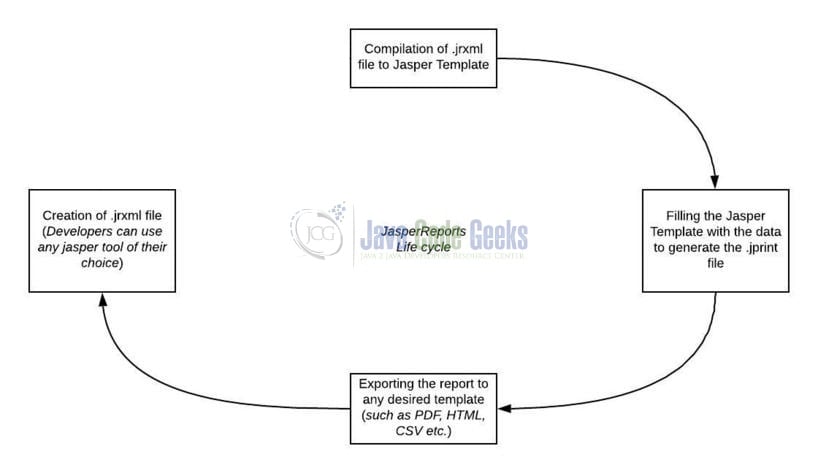
JasperReports is an open-source reporting library. It is used to prepare reports in various formats such as PDF, HTML, XLS or CSV's. This library creates page-oriented ready-to-print documents in a simple manner. The following flow chart illustrates the creation of reports.
JasperReports with Spring Boot - Report Creation
Fig. 1: Report Creation Flowchart

In this tutorial, we will create a spring boot application that loads the sample employee data and creates a pdf report using the jasper-report library. To follow this concept, let us open the eclipse ide and implement this tutorial. But before going any further I'm assuming that readers are aware of the concepts of creating and running a basic spring boot application.

2. JasperReports with Spring Boot

Here is a systematic guide for implementing this tutorial.

2.1 Tools Used

We are using Eclipse Kepler SR2, JDK 8, and Maven.

2.2 Project Structure

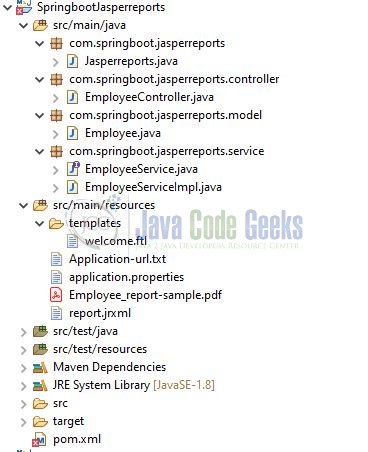
In case you're confused about where you should create the corresponding files or folder, let us review the project structure of the spring boot application.
JasperReports with Spring Boot - Project structure
Fig. 2: Project structure

Let us start building the application!

3. Creating a Springboot application

Below are the steps involved in developing the application.

3.1 Maven Dependency

Here, we specify the dependency for the spring boot, free marker, and jasper-reports. Maven will automatically resolve the other dependencies. The updated file will have the following code.

pom.xml

01

02

03

04

05

06

07

08

09

10

11

12

13

14

15

16

17

18

19

20

21

22

23

24

25

26

27

28

29

30

31

32

33

34

35

36

37

38

39

40

41

42

43

44

45

46

47

48

49

50

< modelVersion >4.0.0</ modelVersion >

< groupId >com.springboot.jasperreports</ groupId >

< artifactId >SpringbootJasperreports</ artifactId >

< version >0.0.1-SNAPSHOT</ version >

< name >Springboot Jasper Reports example</ name >

< parent >

< groupId >org.springframework.boot</ groupId >

< artifactId >spring-boot-starter-parent</ artifactId >

< version >2.2.2.RELEASE</ version >

</ parent >

< properties >

< java.version >1.8</ java.version >

</ properties >

< dependencies >

< dependency >

< groupId >org.springframework.boot</ groupId >

< artifactId >spring-boot-starter-web</ artifactId >

</ dependency >

< dependency >

< groupId >org.springframework.boot</ groupId >

< artifactId >spring-boot-starter-freemarker</ artifactId >

</ dependency >

< dependency >

< groupId >net.sf.jasperreports</ groupId >

< artifactId >jasperreports</ artifactId >

< version >6.11.0</ version >

</ dependency >

< dependency >

< groupId >com.github.javafaker</ groupId >

< artifactId >javafaker</ artifactId >

< version >1.0.1</ version >

</ dependency >

</ dependencies >

< build >

< finalName >SpringbootJasperreports</ finalName >

</ build >

</ project >

3.2 Application Properties

Create a new properties file at the location: SpringbootJasperreports/src/main/resources/ and add the following code to it.

application.properties

1

2

3

4

5

6

7

### Server port ###

server.port=10091

### Springboot application name ###

spring.application.name=SpringbootJasperreports

### Freemarker configuration ###

spring.freemarker.template-loader-path= classpath:/templates

spring.freemarker.suffix= .ftl

3.3 Report Template File

Create a report template file at the location SpringbootJasperreports/src/main/resources/ and add the following code to it. A .jrxml file contains the template definition in an XML format i.e. this JasperReport template file includes design elements such as text-fields, charts, parameters, variables and the report layout. In this template, we have four fields that are mapped to the elements of the data source bean. It also has the text-field element that is filled with dynamic data from the application.

report.jrxml

01

02

03

04

05

06

07

08

09

10

11

12

13

14

15

16

17

18

19

20

21

22

23

24

25

26

27

28

29

30

31

32

33

34

35

36

37

38

39

40

41

42

43

44

45

46

47

48

49

50

51

52

53

54

55

56

57

58

59

60

61

62

63

64

65

66

67

68

69

70

71

72

73

74

75

76

77

78

79

80

81

82

83

84

85

86

87

88

89

90

91

92

93

94

95

96

97

<? xml version = "1.0" encoding = "UTF-8" ?>

<! DOCTYPE jasperReport PUBLIC "//JasperReports//DTD Report Design//EN"

< jasperReport

name = "report2" pageWidth = "595" pageHeight = "842"

columnWidth = "555" leftMargin = "20" rightMargin = "20"

topMargin = "20" bottomMargin = "20" >

< parameter name = "createdBy" class = "java.lang.String" />

< field name = "Id" class = "java.lang.Integer" >

< fieldDescription >

<![CDATA[id]]>

</ fieldDescription >

</ field >

< field name = "Name" class = "java.lang.String" >

< fieldDescription >

<![CDATA[name]]>

</ fieldDescription >

</ field >

< field name = "Designation" class = "java.lang.String" >

< fieldDescription >

<![CDATA[designation]]>

</ fieldDescription >

</ field >

< field name = "Department" class = "java.lang.String" >

< fieldDescription >

<![CDATA[department]]>

</ fieldDescription >

</ field >

< background >

< band splitType = "Stretch" />

</ background >

< title >

< band height = "42" splitType = "Stretch" >

< staticText >

< reportElement x = "64" y = "0" width = "481" height = "42" />

< textElement textAlignment = "Center" >

< font size = "20" isBold = "true" />

</ textElement >

< text >

<![CDATA[Employee Report]]>

</ text >

</ staticText >

</ band >

</ title >

< columnHeader >

< band height = "61" splitType = "Stretch" >

< textField >

< reportElement x = "456" y = "21" width = "99" height = "20" />

< textElement />

< textFieldExpression >

<![CDATA[$P{createdBy}]]>

</ textFieldExpression >

</ textField >

< staticText >

< reportElement x = "398" y = "21" width = "58" height = "20" />

< textElement />

< text > <![CDATA[Created By:]]> </ text >

</ staticText >

</ band >

</ columnHeader >

< detail >

< band height = "20" splitType = "Stretch" >

< textField >

< reportElement x = "0" y = "0" width = "50" height = "15" />

< textElement textAlignment = "Right" verticalAlignment = "Middle" />

< textFieldExpression class = "java.lang.Integer" >

<![CDATA[$F{Id}]]>

</ textFieldExpression >

</ textField >

< textField >

< reportElement x = "200" y = "0" width = "100" height = "15" />

< textElement textAlignment = "Left" verticalAlignment = "Middle" />

< textFieldExpression class = "java.lang.String" >

<![CDATA[$F{Name}]]>

</ textFieldExpression >

</ textField >

< textField >

< reportElement x = "300" y = "0" width = "100" height = "15" />

< textElement textAlignment = "Right" verticalAlignment = "Middle" />

< textFieldExpression class = "java.lang.String" >

<![CDATA[$F{Designation}]]>

</ textFieldExpression >

</ textField >

< textField >

< reportElement x = "500" y = "0" width = "100" height = "15" />

< textElement textAlignment = "Left" verticalAlignment = "Middle" />

< textFieldExpression class = "java.lang.String" >

<![CDATA[$F{Department}]]>

</ textFieldExpression >

</ textField >

</ band >

</ detail >

</ jasperReport >

3.4 Freemarker Template File

Create a freemarker template file at the location SpringbootJasperreports/src/main/resources/templates/ and add the following code to it. This file will be shown to the users on the application startup.

welcome.ftl

3.5 Java Classes

Let us write all the java classes involved in this application.

3.5.1 Implementation/Main class

Add the following code to the main class to bootstrap the application from the main method. Always remember, the entry point of the spring boot application is the class containing @SpringBootApplication annotation and the static main method.

Jasperreports.java

01

02

03

04

05

06

07

08

09

10

11

12

13

14

15

16

package com.springboot.jasperreports;

import org.springframework.boot.SpringApplication;

import org.springframework.boot.autoconfigure.SpringBootApplication;

/**

* Main implementation class which serves two purposes in a spring boot application: Configuration and bootstrapping.

* @author yatin-batra

*/

@SpringBootApplication

public class Jasperreports {

public static void main(String[] args) {

SpringApplication.run(Jasperreports. class , args);

}

}

3.5.2 Model class

Add the following code to the Employee model class.

Employee.java

01

02

03

04

05

06

07

08

09

10

11

12

13

14

15

16

17

18

19

20

21

22

23

24

25

26

27

28

29

30

package com.springboot.jasperreports.model;

public class Employee {

private final Integer id;

private final String name;

private final String designation;

private final String department;

public Employee( final Integer id, final String name, final String designation, final String department) {

this .id = id;

this .name = name;

this .designation = designation;

this .department = department;

}

public Integer getId() {

return id;

}

public String getName() {

return name;

}

public String getDesignation() {

return designation;

}

public String getDepartment() {

return department;

}

}

3.5.3 Service class

Add the following code to the service class where we will prepare the dummy data for an employee.

EmployeeServiceImpl.java

01

02

03

04

05

06

07

08

09

10

11

12

13

14

15

16

17

18

19

20

21

22

23

24

25

26

27

28

29

30

package com.springboot.jasperreports.service;

import java.util.ArrayList;

import java.util.List;

import java.util.Random;

import org.springframework.stereotype.Service;

import com.github.javafaker.Faker;

import com.springboot.jasperreports.model.Employee;

@Service

public class EmployeeServiceImpl implements EmployeeService {

final Faker faker = new Faker();

final Random random = new Random();

@Override

public List<Employee> findAll() {

final List<Employee> employees = new ArrayList<>();

for ( int count= 0 ; count< 21 ; count++) {

employees.add( new Employee(random.nextInt( 30 + 1 ), faker.name().fullName(),

faker.job().title(), faker.job().field()));

}

return employees;

}

}

3.5.4 Controller class

Add the following code to the controller class designed to handle the incoming requests. The class exposes two methods to display the welcome page of the application and generates the employee report.

EmployeeController.java

01

02

03

04

05

06

07

08

09

10

11

12

13

14

15

16

17

18

19

20

21

22

23

24

25

26

27

28

29

30

31

32

33

34

35

36

37

38

39

40

41

42

43

44

45

46

47

48

49

50

51

52

53

54

55

56

57

58

59

60

61

62

63

64

65

66

67

68

69

70

71

72

73

74

75

76

77

78

79

80

81

82

83

84

85

86

87

package com.springboot.jasperreports.controller;

import java.io.InputStream;

import java.util.HashMap;

import java.util.List;

import java.util.Map;

import org.slf4j.Logger;

import org.slf4j.LoggerFactory;

import org.springframework.beans.factory.annotation.Autowired;

import org.springframework.stereotype.Controller;

import org.springframework.web.bind.annotation.GetMapping;

import org.springframework.web.bind.annotation.RequestMapping;

import org.springframework.web.servlet.ModelAndView;

import com.springboot.jasperreports.model.Employee;

import com.springboot.jasperreports.service.EmployeeService;

import net.sf.jasperreports.engine.JRException;

import net.sf.jasperreports.engine.JasperCompileManager;

import net.sf.jasperreports.engine.JasperExportManager;

import net.sf.jasperreports.engine.JasperFillManager;

import net.sf.jasperreports.engine.JasperPrint;

import net.sf.jasperreports.engine.JasperReport;

import net.sf.jasperreports.engine.data.JRBeanCollectionDataSource;

@Controller

@RequestMapping (value = "/api" )

public class EmployeeController {

final Logger log = LoggerFactory.getLogger( this .getClass());

final ModelAndView model = new ModelAndView();

@Autowired

EmployeeService eservice;

@GetMapping (value= "/welcome" )

public ModelAndView index() {

log.info( "Showing the welcome page." );

model.setViewName( "welcome" );

return model;

}

@GetMapping (value = "/view" )

public ModelAndView viewReport() {

log.info( "Preparing the pdf report via jasper." );

try {

createPdfReport(eservice.findAll());

log.info( "File successfully saved at the given path." );

} catch ( final Exception e) {

log.error( "Some error has occurred while preparing the employee pdf report." );

e.printStackTrace();

}

model.setViewName( "welcome" );

return model;

}

private void createPdfReport( final List<Employee> employees) throws JRException {

final InputStream stream = this .getClass().getResourceAsStream( "/report.jrxml" );

final JasperReport report = JasperCompileManager.compileReport(stream);

final JRBeanCollectionDataSource source = new JRBeanCollectionDataSource(employees);

final Map<String, Object> parameters = new HashMap<>();

parameters.put( "createdBy" , "javacodegeek.com" );

final JasperPrint print = JasperFillManager.fillReport(report, parameters, source);

final String filePath = "\\" ;

JasperExportManager.exportReportToPdfFile(print, filePath + "Employee_report.pdf" );

}

}

4. Run the Application

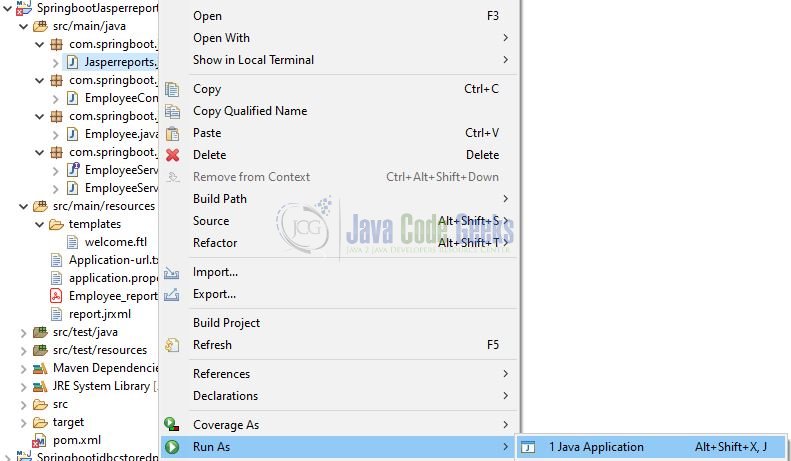
To execute the application, right-click on the Application.java class, Run As -> Java Application.
JasperReports with Spring Boot - Run the Application
Fig. 3: Run the Application

5. Project Demo

Developers can hit the below URL that will open the index of the application. On the index page, the application has the 'Generated Pdf' button that will generate the employee report as shown in the below figure.

http://localhost:10091/api/welcome
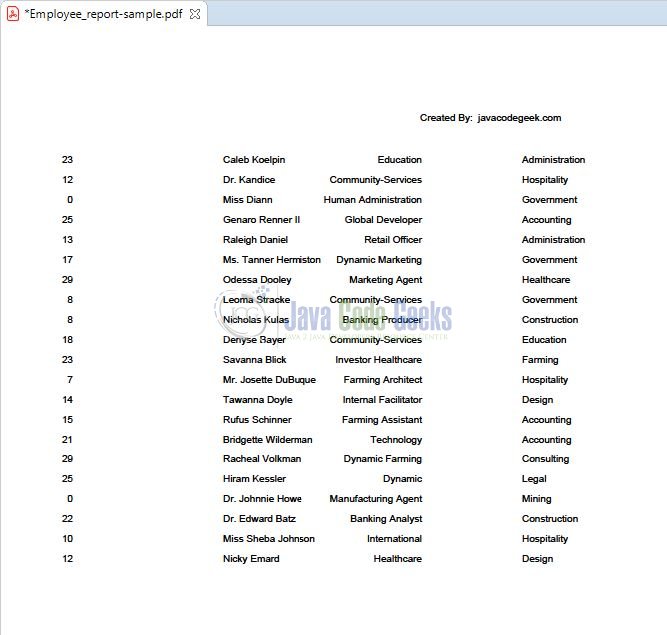
Fig. 4: Employee Report

That is all for this tutorial and I hope the article served you whatever you were looking for. Happy Learning and do not forget to share!

6. Conclusion

In this section, developers learned how to use JasperReports with a spring boot application. Developers can download the sample application as an Eclipse project in the Downloads section.

7. Download the Eclipse Project

This was an example of using JasperReports with a Spring boot application.

ramoslarmincess1998.blogspot.com

Source: https://examples.javacodegeeks.com/jasperreports-with-spring-boot/

Post a Comment for "Rest in Jasperreports Server Simple Svn Versioning and Continuous Integration"